
You want it? Go get it! Sitting on the sidelines or in the stands is not going to get you where you desire to go.
Smarts and talent are overrated; there are plenty of down-on-their-luck geniuses out there, but nothing beats hard work and resilience.
And it’s especially true if you are building a business. The person who says I’m smarter than all of you and claims to have it all figured out is the first to quit because they have no idea what they are doing. Act, learn, act, learn, act, learn, then fail, get better, fail again, try harder, work more, and most importantly, never give up. There’s your messy but tried-and-true formula for success.
Follow the recipe and then share your ingredients with others, because your recipe matters, and your story matters!
Everyone has a story. Welcome to Mark Brodinsky Storytelling.
____________________________________________________________
Mark Brodinsky Storytelling: A “Rahe” of Light

The bright eyes + The big smile + The bigger dimples + The great laugh. Add those together, and you’ve got Kiley Rahe.
It doesn’t hurt that Kiley’s maiden name is Laughlin. Yes, that’s right, the core part of that last name is “laugh.” Talk to Kiley, and you’ll both be laughing shortly. Because Kiley knows life is meant to be lived and how to find the silver lining in nearly everything. Kiley knows the secret, and it’s one that it seems not enough people embrace: Life is hard, but it’s beautiful.
You might not know that Kiley learned a lot about life by dancing through it – literally dancing through life – which was tough, but rewarding. And it’s something that still pays dividends today with her career at USHEALTH Advisors.

“I started dancing kind of late,” says Kiley. “I actually started as a ballerina in fifth grade, which in the ballet world is a little late to start. So I doubled down. I had a Cuban teacher. She was very strict, and then I ended up going to private school. My parents put me there because I was small for my age and wanted me out of the public middle school in South Florida. I wanted to go because you didn’t have to do Phys Ed. You could go to ballet instead. And that’s what got us into this private prep school. But we did the Nutcracker every year. I went away to summer intensive programs every summer. So I played a little catch-up to get to where I needed to be in my age group. But I got to study at Central Pennsylvania Youth Ballet, which is a very prestigious school in Carlisle, Pennsylvania.”

“And then I went to the Pennsylvania Ballet in Philadelphia, and I spent a couple of summers there, and then I went to Point Park in Pittsburgh for the summer. But once I got older, puberty hit, and you’re like, I probably have peaked at this. I don’t think it’s going to work. And I was getting ready to start my senior year in high school, and I was like, I think I want to have balance in my life now and go to football games and do some of the things that I wasn’t able to do because it’s a sacrifice. But I still take classes every once in a while. I’m not nearly as good, but it’s hard to quit it. But it taught me resilience, it taught me rejection. It taught me sustainability to keep persevering forward, and if you get knocked down, you can quit, or you can find another solution.”
“And I’ve carried that through my life too. I mean, we all face challenges, and you can face a challenge and say, “Okay, that’s it. I’m going to get depressed or retreat into myself.” Or you say, “Okay, well, we all deal with drama every day. We all have stuff coming our way. No one said it was going to be easy. In fact, if you do hard things, it’s going to be harder, but how do you overcome? So I tend to be introspective. I’m my father’s daughter, so we look at things from a solutions-based perspective; you can deposit results or excuses, not both. And so it’s okay, let’s find a way.”

We could end the story right here. Go back to Kiley’s perspective on resilience, rejection, perseverance, and the mindset to NEVER quit. Drop the mic on all of it.
Kiley is using all those strong character traits to build a business and has been doing very well for years at USHA. Kiley is a Division Sales Leader with more than $85 million in team production and has personally written nearly $3 million in individual policies.
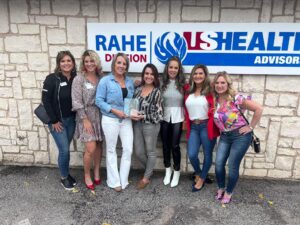
But this is not where Kiley began, sales wasn’t her thing. A familiar story at USHA, yet the best of the best here follow the formula: Take a chance, take the leap of faith – learn, act, fail, learn, act, fail, learn, act, fail, until you finally find success, and once you do, there is nothing stopping you; the sky’s the limit.
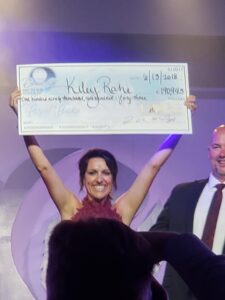
Kiley’s success can be traced all the way back to the top – the inaugural internship with the President and CEO of USHEALTH Group, Troy McQuagge, even before Troy was at the helm of this great American company.
“But I was studying business management in college, and I was really more interested in how they put on the event. I was interested in how Troy figured out what to talk about. How did the business side work? So I introduced myself to him. I was 18, or 19, and I was like, “Do you do internships?” And he said, “Never have, but that doesn’t mean we won’t do one.” So anyway, he set me up on a summer internship. I came in, and I helped Troy prepare for the Leaders Meeting. And he was amazing. He took me to every meeting he went to. I mean every single one.”

“Troy would have conference calls, one-on-ones, with his regional sales leaders. He would tell me, “I want you to sit in and hear how we do this.” When he was writing his speeches, he would say, “I want you to sit in here and see how we develop this and the ideas that come out, and introduced me to the entire business strategy.” And so I came back out to Texas again and helped with Reunion. They offered me a job making a whopping $32,000 a year. And in my business background, I thought that was enough money to survive. I moved out here, uprooted my life two weeks after graduation, and then spent almost eight years on that side of the business. I did the agency side for maybe a year and a half to two years, and then they moved me to the corporate side. They brought me into management. That was fun. I was 25, maybe 24, managing 50-year-olds. They had way more experience than I did, but they moved me into a compliance role. So I did that for many years. I was a product trainer.”
“But I found out that in corporate America, you’re very replaceable. I got my master’s degree from TCU while I was working there, and then they capped me at $75,000 a year and said I wouldn’t make any more. And so then I started looking at other opportunities, and my brother Mikey and my dad both told me that most likely, I won’t make much more in corporate America because there’s going to be someone younger, cheaper, and smarter that comes in behind me that’ll do whatever they want you to do, the hours they want you to do and pay them less money.”
And so my Dad, Mike, said, “Kiley, you have a choice to make. Is that who you want to be down the road? And if so, then you’re going to go all in, and you’re going to do that. And I don’t want to hear you complain about your finances, paid time off, vacations, or your lifestyle. Or, do you want to bet on yourself and go into sales? This was 2009, and they were just starting out as the company, Security Health Advisors, which would shortly become USHEALTH Advisors. My dad and my brother Garrett were here, and my dad was like, “Now would be a good time to start because you’ll be coming in at the ground level of something. Try it for six months, put it on your resume if nothing else. I actually met with Troy to ask him what he thought about whether I could do sales. But they were all like, “Try it. Go all in. If you can’t do it, at least you can add it to your resume, and then go somewhere else. If you can do it, what do you have to lose?”

And Kiley almost lost, getting beaten up by the business and not making any money for more than a month. In the meantime, her brothers Mikey and Garrett were eating it up at USHEALTH Advisors, becoming the best of the best.
“I thought to myself, I’ve never been bad at anything in my life,” says Kiley. “And I mean, this sounds so strange, but I looked at Garrett, my younger brother, who was not the best at school, not the best at all. He would ask me how to fill out a check. I was like, “What?” And meantime, he was just killing it at USHA. So then I thought, if Garrett can do it, because Garrett was one of the top salespeople here, then I can do it too.”

“And I came in and thought I knew better how to handle the scripts and make the phone calls. And I was like, I don’t need to make that many phone calls. I’m better at this than other people. But this business is very humbling because I sucked at it. I didn’t make a check for five weeks.”
“And so finally, Mikey and Garrett were actually working out of the same office, and Mikey said, “Look, if you’re going to make this work, you can’t do this in Texas. You need to fly to Florida, and I want to hear you on the phone. I want to hear what you’re saying.” And so this is family, this isn’t a stranger telling me this. And so I got there, and Mikey said, “Whose script is that? ” And I was like, ‘Well, I took yours, but I made it my own.” And he said, “Here’s what I want you to do. You’re going to go back. You’re going to study that script again. I don’t care if you look down and read it word for word. That’s better than what you’re doing on your own. You have to be coachable, and you have to check your ego at the door.” And I wasn’t doing either of those things because I wanted to make it my own, and I figured I’d been good at everything and I was smarter than everyone.”
“So I came back in an hour later, and I was l literally reading it, looking down. Mikey says, “Kiley, that was about a thousand times better than what you did the first time. That’s why you’re not making money. Just do that. ” So I came back to Texas, and I made my first sale. I still remember him. He was out in Boyd, Texas, an older gentleman, a really nice guy. I made $1,500 on my first sale, and it was six weeks into the business, and the client got approved, thank goodness. He stayed with me until he hit Medicare age, but I was like, I just made $1,500 in a week. With my $70,000 salary, I was making $3,300 a month! If I could just do that again next week, what would be wrong with that? So that’s when I was like, “Okay, now I’m going to be all in.”
When you live the truth you desire to teach, it’s easy to share your lessons. Kiley can now share her experiences to encourage others on how to start in this business, the right way.

When they say “be coachable,” I get what they mean now,” says Kiley. “I was not doing it that way. So that was probably my biggest challenge. I think the other challenge is that in corporate America, it is very easy to be mediocre and still have a job. So I was on autopilot. My job was very easy. I didn’t have to work that hard. I could show up to work for eight hours a day and probably really only work two of them, and I was the best person in my department. You get into sales, you’re hustling, you’re exhausted at the end of the day. If you’re spending your time on busywork, you’re not getting paid. And that’s the opposite of the mentality in corporate America.”
“So that was also very challenging, just understanding we’re here to get results. We’re not here just to say we’re here. And those are very different things. When I interview people, I tell them, “I want someone results-driven. Let me explain to you what that means. That means if I tell you I want to pitch before lunch, you don’t take a lunch break until you pitch. Whether that’s at 11:00 AM, 12:00, 1:00, 2:00, or you’re eating a sandwich at your desk while you’re making phone calls. And the same thing in the afternoon. The clock may say it’s 5:00, but if you haven’t helped someone today, your day’s not over. And that’s a totally different mindset from the corporate mindset of, “I clock in at 8:00, and I’m going to clock out at 5:00, 5:30, 6:00, whenever it is, and I get paid whether I was good at what I did today or I wasn’t.”

And here is Kiley, sixteen years later, making sales, leading teams, and loving her life at USHA. Getting to see both sides of the business mattered to Kiley; the corporate side capped her, while the sales side set her free to set sail for whatever destination she desired. But it doesn’t mean the ride has been sunshine and roses, first there was the tough business start, then personally, God tested her in ways she never could have imagined.
Finding the silver lining in that wasn’t easy.
“My ex-husband, Ronnie, and I experienced two stillbirths, which is very unusual after having a healthy child, who is our son Chase, now 13. To this day, the doctors don’t know why. But lying in the hospital bed, after the birth of our second stillborn, Caroline, I thought about one of my best friends who had adopted just because he and his wife wanted to. They had biological children of their own. And I called my friend from the hospital bed, and I said, “I want to get the ball rolling on adoption because this shouldn’t have happened twice. I think God’s telling me he has a different plan for me, and I’m kind of going against what he wants me to do, which was where I was at the time. And whether that’s true or not, I don’t know, but I tend to lean into that; as to that’s why it happened.”
Kiley’s silver lining was quickly bringing another life into the family after tragically losing two lives, back-to-back.
That’s how, now 10-year-old Charlotte (Charlie) came into the picture. Kiley and Ronnie adopted Charlie from birth, matching with Charlie’s birth mom when she was almost 20 weeks pregnant. Kiley and Ronnie co-parent, and their children are thriving and give Kiley’s life purpose every day.

Kiley says being a mom helps her relate to families when selling health insurance policies and to serve the people on her team, with the attitude that only the experience as a mom can provide.
Kiley says, “One of the biggest compliments I get from someone on my team is when they say things like, ‘Kiley, this has changed my life and you being there and showing me that you can do this,’ or someone saying, ‘Thanks for taking me out to lunch, or buying me a computer when I couldn’t afford a computer,” or the agent who says, “Thanks for putting leads in my hand because you told me that you knew I was going to get a sale today and I was down on my luck.’ All of these experiences fuel me.”

“This is so rewarding to me to get up every day and do this,” says Kiley. “I spent seven years in corporate America. It felt like 70 years, and I didn’t have a bad gig there either, but it still was very draining. I’ve spent 16 years here at USHEALTH Advisors, and I feel like I started yesterday. There’s always something to learn. There’s always a new person to meet. There’s always an opportunity to make more money. It does not feel like 16 years at all. I used to tell Dad I didn’t understand why he didn’t want to retire. And he’d say, “You retire, you get old, you have no purpose. Why would I do that? This is fun for me.”


What’s also helped Kiley is not only the advice from her father, but also her other “father figure”, Troy McQuagge. Kiley says that during their time together, Troy taught her a valuable lesson she still uses today as she assesses her opportunities and her life.
“We all have drama. We all have challenges. We all have hardships,” says Kiley. “It’s a conscious decision every single day to choose happiness. Life is hard. So you kind of choose your hard. But what Troy said to me all those years ago was, “Kiley, if something is 51% good, then you should decide to play full out and go all in because it’s never going to be 100% good. And if that’s what you’re waiting for, you’re always going to be disappointed. And so if it is more good than it is bad, just choose to go all in, just choose to be happy.”

“And I’ve used that time and time again in my life, so if I think it’s more 51% good than 51% bad, then I’m moving forward. And if it gets to the point that it is 51% bad, then maybe we have to pivot and change plans. But I think choosing happiness is the key. It’s not like my life is easy; no one’s is, but I choose happiness every day.”

Until next time, thanks for taking the time.
Your Storyteller,
Mark Brodinsky